






















Global buyers are entering a more demanding artificialstone market in 2026. Product names can sound similar, yet their performance differs sharply. Quartz suits busy kitchens and hotel counters. Acrylic supports seamless edges and easier repairs. Sintered stone tolerates heat, sunlight, and heavy commercial use. Recycled glass offers striking color, although availability may vary by region.
Material specialist Dr. Andrew H. Dent often emphasizes, “The best material is chosen by performance, not appearance alone.” This principle guides our comparison of the 2026 top artificial stone types. We examine composition, surface durability, water resistance, maintenance, fabrication, and long-term value. We also consider shipping weight, slab dimensions, edge processing, and local installer skills. A beautiful slab may fail when cutting equipment is poor. Small details matter.
This guide is practical, but it is not perfect. Climate, building habits, and supplier quality can change the result. A surface tested in a dry showroom may behave differently beside a humid coastline. Buyers should request technical sheets, sample slabs, batch information, and warranty terms before ordering. Certifications deserve careful checking. Marketing language alone is not enough.
Some materials resist stains well. Others repair more easily. No type wins every project. The right choice depends on use, budget, design goals, and after-sales support. This introduction helps global buyers compare options with clearer expectations, fewer assumptions, and more realistic purchasing decisions.
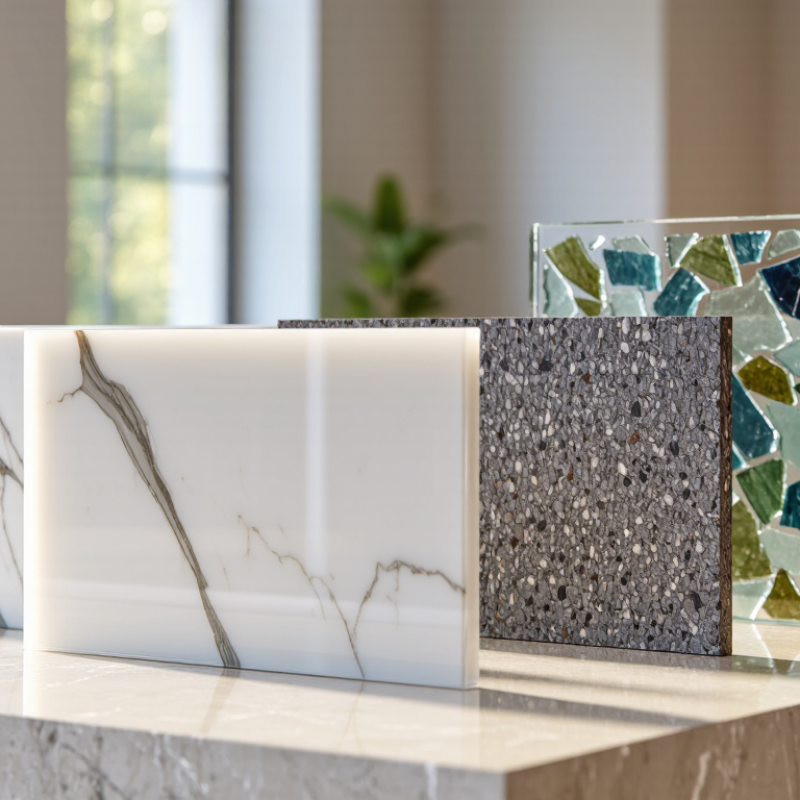
2026 Top Artificial Stone Types for Global Buyers
Artificial stone is a manufactured surface designed to imitate natural stone. Its definition remains broad, and trade labels are not always consistent. Common types include engineered quartz, solid surface, cultured marble, and sintered stone. Each uses a different balance of minerals, binders, pigments, and additives.
Engineered quartz usually combines crushed quartz with polymer resin and color pigments. Many formulations contain roughly 90% mineral aggregate, although the ratio varies by producer. Solid surface relies more heavily on acrylic or polyester resin, creating a smooth, repairable sheet. Sintered stone uses selected minerals compacted under intense heat and pressure, with little or no resin. It is dense, but edge finishing still requires skilled fabrication.
The market is expanding. Grand View Research valued the global engineered stone market at about USD 24.9 billion in 2023 and projected a 7.4% CAGR from 2024 to 2030. Applications include kitchen worktops, bathroom counters, wall panels, flooring, furniture tops, and commercial reception desks. In practice, quartz suits detailed indoor joinery, while sintered panels can handle stronger heat and ultraviolet exposure.
Performance is not identical across suppliers. A buyer should check water absorption, stain resistance, slip resistance, and thermal-shock test results. The ASTM and ISO references matter. Marketing terms can sound precise, yet they may hide formulation differences. That is the uncomfortable part. A low-maintenance claim still depends on installation quality, joint design, and actual cleaning habits.
| Artificial Stone Type | Definition | Typical Composition | Main Manufacturing Method | Key Performance Characteristics | Common Applications | Suitable Buyer Priorities | Relative Cost Level |
|---|---|---|---|---|---|---|---|
| Engineered Quartz | A factory-produced slab material made by combining mineral aggregates with a polymer binder and pigments. | Usually predominantly quartz aggregate, with resin binder, pigments, and small amounts of additives. | Mixing, vacuum compaction, vibration, pressing, curing, and surface polishing. | High hardness, consistent pattern, low porosity, easy routine cleaning, and good resistance to household staining. Prolonged exposure to high heat can damage the resin binder. | Kitchen countertops Bathroom vanities Wall cladding Reception counters | Uniform appearance, low maintenance, indoor countertop performance, and design consistency. | |
| Sintered Stone | A dense stone-like surface produced by compacting and heating selected minerals at very high temperature. | Natural minerals such as feldspathic materials, silica, clays, and other mineral components; generally no conventional resin binder. | High-pressure compaction followed by high-temperature sintering, then cutting and finishing. | Very low water absorption, high resistance to scratching, heat, ultraviolet exposure, and many household chemicals. Large slabs require careful handling and professional installation. | Kitchen worktops Exterior façades Flooring Wall panels Outdoor kitchens | Outdoor durability, heat resistance, color stability, large-format design, and long service life. | |
| Porcelain Slab | A large-format ceramic surface made from refined mineral raw materials and fired to achieve a dense, hard body. | Kaolin and other clays, feldspar, silica, mineral pigments, and ceramic additives. | Spray drying, pressing, decoration, and high-temperature kiln firing. | Very low water absorption, strong resistance to ultraviolet light, heat, frost, and abrasion. Cutting and edge fabrication require suitable diamond tools and skilled processing. | Countertops Flooring Bathrooms Ventilated façades Furniture surfaces | Thin large panels, exterior use, hygienic surfaces, and resistance to environmental exposure. | |
| Solid Surface | A homogeneous non-porous surfacing material that can be cut, shaped, joined, and refinished during fabrication. | Acrylic or polyester resin, mineral fillers such as alumina trihydrate, pigments, and performance additives. | Resin and filler blending followed by casting or compression molding, curing, cutting, and sanding. | Seamless appearance, repairability, thermoformability in selected grades, and good stain resistance. It is generally more susceptible to scratching and heat damage than dense ceramic or sintered surfaces. | Healthcare counters Retail desks Reception areas Integrated sinks Wall panels | Seamless joints, curved designs, integrated sinks, hygiene-focused projects, and repairability. | |
| Cultured Marble | A molded decorative composite designed to resemble marble and commonly used for sanitary and interior components. | Calcium carbonate or other mineral filler, polyester resin, pigments, gel coat, and surface additives. | Molding, vibration or casting, curing, trimming, and polishing or gel-coat finishing. | Smooth decorative surface, molded shapes, comparatively efficient production, and good suitability for bathroom components. Heat, impact, and chemical performance depends on the formulation and protective finish. | Bathtub surrounds Shower walls Vanity tops Window sills | Bathroom renovation, molded dimensions, coordinated colors, and economical project supply. | |
| Cultured Onyx | A translucent decorative composite formulated to imitate the visual effect of natural onyx. | Resin, mineral fillers, pigments, translucent particles, and a protective surface layer. | Casting or molding with controlled pigment distribution, curing, trimming, and polishing. | Decorative veining, color depth, and potential translucency for backlighting. It requires careful protection from abrasion, harsh chemicals, and high-impact use. | Feature walls Hotel counters Bar fronts Lighting panels Decorative furniture | Visual impact, custom colors, backlit interiors, and hospitality or retail decoration. | |
| Polymer Concrete | A cement-free or reduced-cement composite in which polymer resin binds mineral aggregates for engineered products. | Mineral aggregates, polymer resin, pigments, fibers, fillers, and curing additives. | Mixing, casting or compression molding, vibration, curing, and surface finishing. | High design flexibility, good dimensional control, lower permeability than many conventional cement products, and suitability for molded architectural components. | Architectural panels Planters Sinks Furniture Landscape elements | Custom shapes, architectural detailing, molded products, and controlled surface finishes. | |
| Cast Stone | A manufactured architectural concrete product designed to reproduce the appearance of cut natural building stone. | Portland cement or other cementitious binder, fine and coarse aggregates, mineral pigments, and admixtures. | Wet casting, dry tamping, vibration, curing, demolding, and surface texturing. | Suitable for architectural detailing, repeatable dimensions, and weather-exposed construction when correctly specified. Performance depends on mix design, curing, reinforcement, and local standards. | Façade trim Columns Window surrounds Masonry units Landscaping | Traditional appearance, repeatable profiles, structural detailing, and compatibility with masonry construction. | |
| Glass Aggregate Surface | A decorative composite that incorporates recycled or manufactured glass particles into a cementitious or resin matrix. | Glass aggregate, cementitious or resin binder, pigments, fillers, and surface sealers. | Aggregate blending, casting or pressing, curing, grinding, honing, and sealing. | Distinctive reflective appearance, broad color possibilities, and potential use of recycled glass. Sealing and correct fabrication are important for stain control and surface durability. | Countertops Flooring Wall panels Public interiors Decorative tiles | Recycled-content design, distinctive appearance, decorative projects, and sustainability objectives. |