10 Best 4 Wheel Drive Forklifts for Sale Worldwide?
Choosing the right machine begins with the ground beneath it. A 4 wheel drive forklift for sale must handle mud, gravel, ramps, loading yards, and uneven warehouse entrances without losing stability. This guide introduces ten respected models available across international markets, comparing lifting capacity, ground clearance, turning control, operator comfort, fuel use, and service support. These details matter when a forklift works eight hours beside stacked pallets and steel containers.
Material-handling consultant David G. Hoover offers a useful reminder: “The strongest forklift is not always the safest or most economical choice.” That principle shapes this selection. A 5-ton machine may impress on paper, yet prove excessive for a narrow farm lane. A compact diesel model might climb confidently, but require more maintenance in dusty conditions. No ranking is flawless. Regional specifications, attachments, tires, and emissions requirements can change the final decision.
Our evaluation considers real operating conditions, manufacturer documentation, dealer reputation, and long-term ownership experience. Readers should verify load charts, warranty terms, spare-parts access, and local certification before purchasing. A bright showroom floor tells only part of the story. Ask how the machine performs after rain, during cold starts, and under repeated side-shift work. Those answers often separate a dependable workhorse from an expensive disappointment.
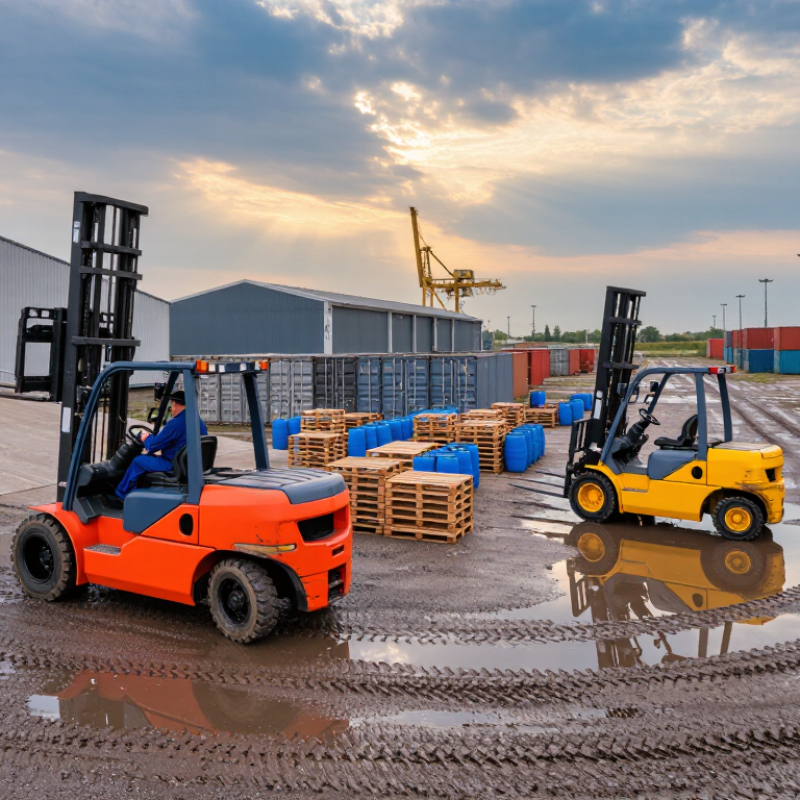
What Makes a Four-Wheel-Drive Forklift Suitable for Global Use
A four-wheel-drive forklift is suitable for global use when it handles more than smooth warehouse floors. Its value appears on wet yards, gravel roads, loading ramps, and uneven construction sites. Four driven wheels improve traction when one side loses contact with the ground. That matters.
A strong mast, protected underbody, and high ground clearance support daily work in rough conditions. Operators should check the rated load at different lift heights. A forklift lifting 3,000 kilograms on level ground may carry less on a slope. Load charts must remain visible and easy to understand. Keep it simple.
Climate also affects reliable performance. Sealed electrical parts help in dusty regions, while corrosion-resistant components suit coastal environments. Cooling systems need careful testing in hot climates. Cold areas may require suitable fluids, battery protection, and enclosed operator controls. Local service access is equally important. A machine that waits weeks for a small part is not globally practical.
Before buying, inspect steering response, tire condition, braking distance, and four-wheel-drive engagement. Test the forklift with a real pallet, not only an empty machine. That test can reveal poor balance. I would also compare spare-part availability, operator training materials, and maintenance intervals. No forklift is perfect. Some models offer excellent traction but consume more fuel during long road movements. Others are efficient but struggle on deep gravel. Buyers should accept this trade-off openly and match the forklift to the actual terrain, climate, workload, and local technical support.
Key Criteria for Comparing Four-Wheel-Drive Forklifts
Comparing four-wheel-drive forklifts requires more than checking lifting capacity. Begin with the rated load center, mast height, ground clearance, turning radius, and gradeability. A 3,000-kilogram rating may fall sharply when the load sits farther forward. Measure that difference carefully. Operators also need clear forward visibility, stable steering, and responsive hydraulic controls on uneven ground. Four-wheel drive improves traction, but it does not remove rollover risk. U.S. OSHA estimates that forklifts cause about 85 workplace deaths and 34,900 serious injuries annually. Safety equipment and operator training therefore deserve equal attention.
Test each forklift in realistic conditions. Use a wet ramp, loose gravel, potholes, and a loaded pallet near the stated capacity. Record stopping distance, tire spin, vibration, noise, and fuel or battery use. Check whether the suspension protects the operator during repeated impacts. ISO 3691-1 provides useful safety requirements for industrial trucks, but local rules may add stricter conditions. Maintenance access also matters: exposed filters, difficult grease points, or slow diagnostics increase downtime. Published gradeability figures can look impressive. They may assume a clean, dry surface and a specific load. That limitation is easy to miss. I would compare service records, parts availability, warranty response, and verified field performance before accepting any sales claim.
Ten Leading Four-Wheel-Drive Forklifts Available Worldwide
Ten Leading Four-Wheel-Drive Forklifts Available Worldwide
Four-wheel-drive forklifts remain practical for ports, timber yards, construction sites, farms, and uneven warehouses. The World Industrial Truck Statistics report recorded more than two million industrial truck deliveries worldwide in 2023. That scale reflects continuing demand for reliable material handling, not simply higher sales volume.
The ten leading configurations include compact diesel units, heavy-duty diesel forklifts, rough-terrain models, telescopic forklifts, container handlers, electric four-wheel-drive units, hybrid units, side-shift forklifts, low-emission gas forklifts, and high-capacity yard trucks. Buyers should compare rated capacity, lift height, turning radius, ground clearance, axle design, tire pattern, and local service access. A 3-ton machine may suit a farm, while a 16-ton unit needs stronger surfaces and trained operators. Fuel consumption matters. So does downtime.
ISO 5053-1 defines key terminology for industrial trucks, while safety regulators commonly emphasize load stability, visibility, operator training, and surface conditions. In field inspections, tire damage and poor load positioning often create greater risk than engine output. Wet ground exposes flaws. Electric four-wheel-drive models can reduce local emissions, but battery charging infrastructure may remain weak in remote yards. Some published market forecasts also combine forklifts with broader warehouse equipment, which can inflate apparent demand. That limitation deserves attention when comparing prices, capacity, and long-term ownership costs.
Best Applications and Industries for Each Forklift Model
The best four-wheel-drive forklifts serve different working environments. A compact electric model suits indoor warehouses, covered loading bays, and narrow concrete yards. A high-capacity diesel model handles steel, stone, and heavy machinery. A rough-terrain model works well on construction sites, farms, and uneven soil. A telescopic model reaches elevated platforms and distant pallets. A side-shifting model improves control when trucks unload beside tight walls.
A narrow four-wheel-drive model fits timber yards with restricted lanes. A low-profile model enters workshops and containers with limited clearance. A corrosion-resistant model supports coastal storage and chemical-free industrial areas. A high-ground-clearance model crosses gravel, mud, and broken surfaces. A container-focused model helps ports and logistics yards move dense loads safely. Real site experience matters. A machine that performs brilliantly on dry gravel may struggle after heavy rain.
Tips: Check tire type, rated capacity, turning radius, mast height, and service access. Test the forklift with your heaviest real load. Do not rely only on brochure figures. Ask operators about visibility and vibration after a full shift.
Fuel choice also depends on ventilation, duty cycle, and charging access. Diesel often suits outdoor work, while electric power reduces indoor exhaust concerns. Still, electric models may lose productivity during long cold-weather shifts. That weakness is easy to overlook. Record ground conditions, load dimensions, travel distances, and seasonal changes before selecting one of these ten forklift types. A practical trial usually reveals more than a polished specification sheet.
How to Select and Purchase the Right Forklift for Your Needs
Selecting a four-wheel-drive forklift begins with the worksite, not the sales page. Measure aisle width, ramp gradients, ground firmness, and doorway height. A machine that handles mud may still fail on a polished warehouse floor. Define the heaviest load, its center of gravity, and lifting height. Keep a written load profile. It prevents guesswork. Check whether the truck needs outdoor weather protection, solid tires, lights, or attachments. Each option changes visibility, stability, maintenance, and purchase cost.
Request the capacity chart for the exact configuration. Rated capacity can decrease sharply at higher lift heights or with a long attachment. Inspect the mast, forks, chains, hydraulic lines, steering joints, and tires in person. Look for uneven wear, oil residue, cracked welds, and delayed hydraulic movement. Ask for service records, operating hours, inspection history, and parts availability. A test drive should include turning, braking, reversing, and climbing the actual slope. Quiet running is useful evidence, but it is not proof.
Compare total ownership cost, including fuel or battery charging, tires, scheduled servicing, training, and downtime. Choose a supplier that provides clear specifications, traceable records, warranty terms, and responsive technical support. Verify that the equipment and operators can meet applicable workplace rules in your location. Do not accept vague promises. A low price can look clever. It may not be. Recheck the quotation against your load profile before paying, because small assumptions often become expensive repairs or unsafe work.
10 Best 4 Wheel Drive Forklifts for Sale Worldwide? How to Select and Purchase the Right Forklift for Your Needs
The chart shows common rated-capacity classes used for four-wheel-drive forklifts in material handling, construction, agriculture, and outdoor logistics. Select a capacity above the heaviest planned load, and verify the rated load center, lifting height, attachment weight, terrain, and operating conditions before purchase. Actual capacity can decrease as lift height increases or when attachments are installed.